

Right now you are surfing a limited version of umu.se. What does this mean?
EU directive 2010/63/EU on the protection of animals used for scientific purposes requires that all personnel (researchers, students and animal technicians) who work with laboratory animals must have undergone adequate training.
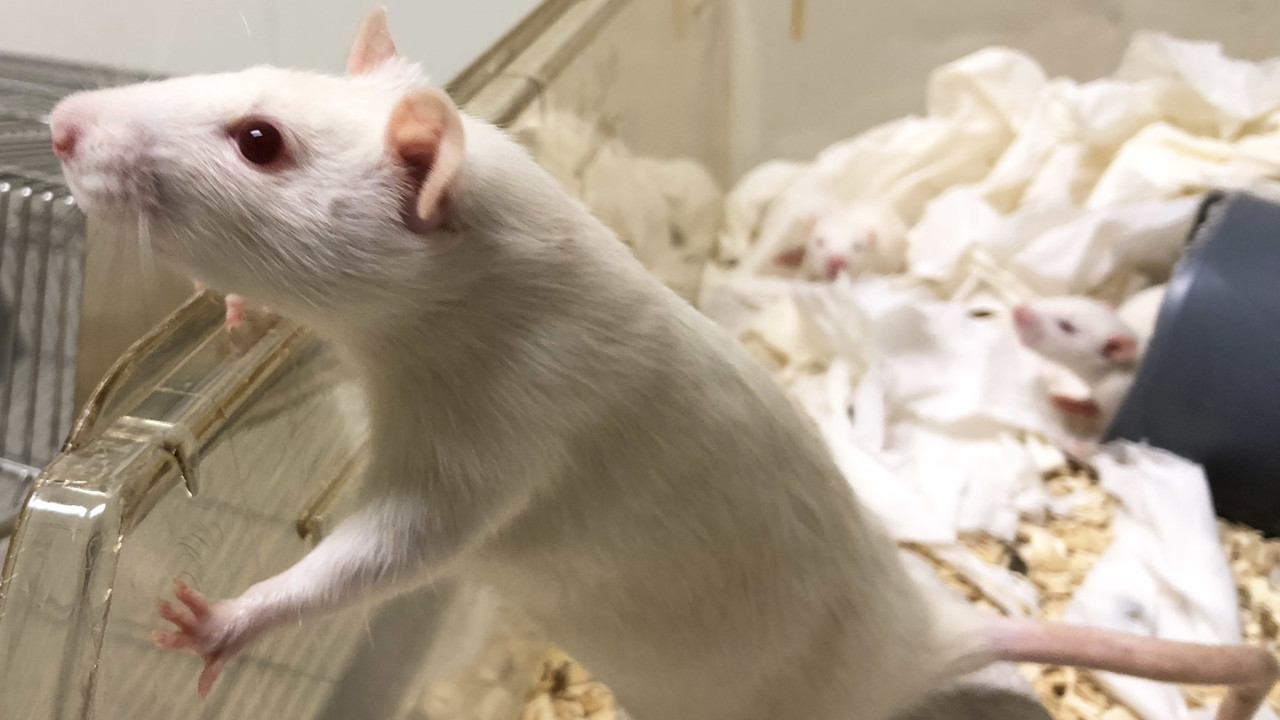
White rat is looking over the rime of the cage
ImageEducation in laboratory animal science is mandatory for those that work with or conduct research involving laboratory animals at Umeå University.
The education is divided into a theoretical web-based part and a practical part. You must pass the theoretical part before you can start the practical part.
Everyone who intend to work with laboratory animals must first pass the theoretical course in Swedish legislation and ethics. This course is mandatory and is the only one who do not include a pratical part.
There are several different theoretical web-based courses you can choose from, which one depends on what species you will work with. Here at Umeå University the main courses held are about Small rodents and Zebrafish.
To gain access and get more information about the theoretical web-based courses, contact the prefekt at UCCB. You as a supervisor/researcher must register yourself and your employees (doctoral students, postdocs and research staff) who need laboratory animal training.
After completionof the theoretical part, you need to inform the UCCB prefekt to be invited to the practical part.
The practical part about Zebrafish can be booked directly with the head of Umeå Zebrafish Facility (UZF) after completion of the theoretical part.
The course about Small rodents include two parts: animal handling and procedures. This course is held once s month during the semester, see course dates
Max five participants at each course.
Teachers: University veterinarian and UCCB staff
Examination: both pratical and written, required to obtain a certificate an gives three European Credit Transfer System (3 ECTS). Please note, to sit the examination is not mandatory to gain access to the facility.
The practical course - is divided into two parts: first a part focuses on handling of animals and then a part focuses on common procedures such as blood sampling and injections.
Autumn term 2025: 4 September, 2 October, 6 November, 4 December
Autumn term 2025: 11 September, 9 October, 20 November, 11 December
Objective: to be able to lift, manage and hold mice and rats in a calm and safe way for inspection and other purposes. Assessment of animal´s health status and body condition is discussed and trained
Handling techniques are demonstrated and trained during the course.
Objective: to calmly and correctly perform commonly used procedures on mice and rats.
Procedures included in the course:
Subcutaneous injection
Intraperitoneal injection
Intravenous injection
Blood sampling
Anesthesia and analgesia
Euthanasia (cervical dislication and CO2)
Instruction and examination on the practical part of the zebrafish course is led by the head of UZF.
The practical part include
After completion of the education in laboratory animal science you must book a mandatory introduction to the animal facility. During the introduction you get information how to enter and exit the facility and how to bring in equpment and disposals. Hygiene rules. How to order animals, keep journals and more.
Only after completion of all these parts you can get access to the facility at UCCB.
Please note that an approved ethical permit is required before you can perform animal experiments, see more at web page Ethical approval.
Swedish 3Rs Center
Swedish 3Rs Center web site is placed at Swedish Board of Agriculture's web site, only in Swedish.
EU Commission web site about animals used for scientific purposes. Legislation and recommendations for compliance.
The on-line course will step-by-step teach you how to do a systematic review and meta-analysis. Systematic review (SR) is a literature review that involves systematically locating, appraising, and synthesising evidence from scientific studies to answer a defined research question based on pre-specified criteria. In SR you generate a powerful search engine to search databases.
SR can be combined with a meta-analysis, a method of combining quantitative results from individual studies identified through the SR. Meta-analysis is an instrument to critically appraise the quality of studies.
Use the code: syrcle to be able to register and to get access to the system.