

Right now you are surfing a limited version of umu.se. What does this mean?
NEWS In a few days, three students from the Department of Computing Science will travel to Karlsruhe, Germany, to represent Umeå University at the programming competition NWERC (North-Western European Regional Contest). The event will take place on November 28–30 and is a regional round of the international programming competition ICPC (International Collegiate Programming Contest).
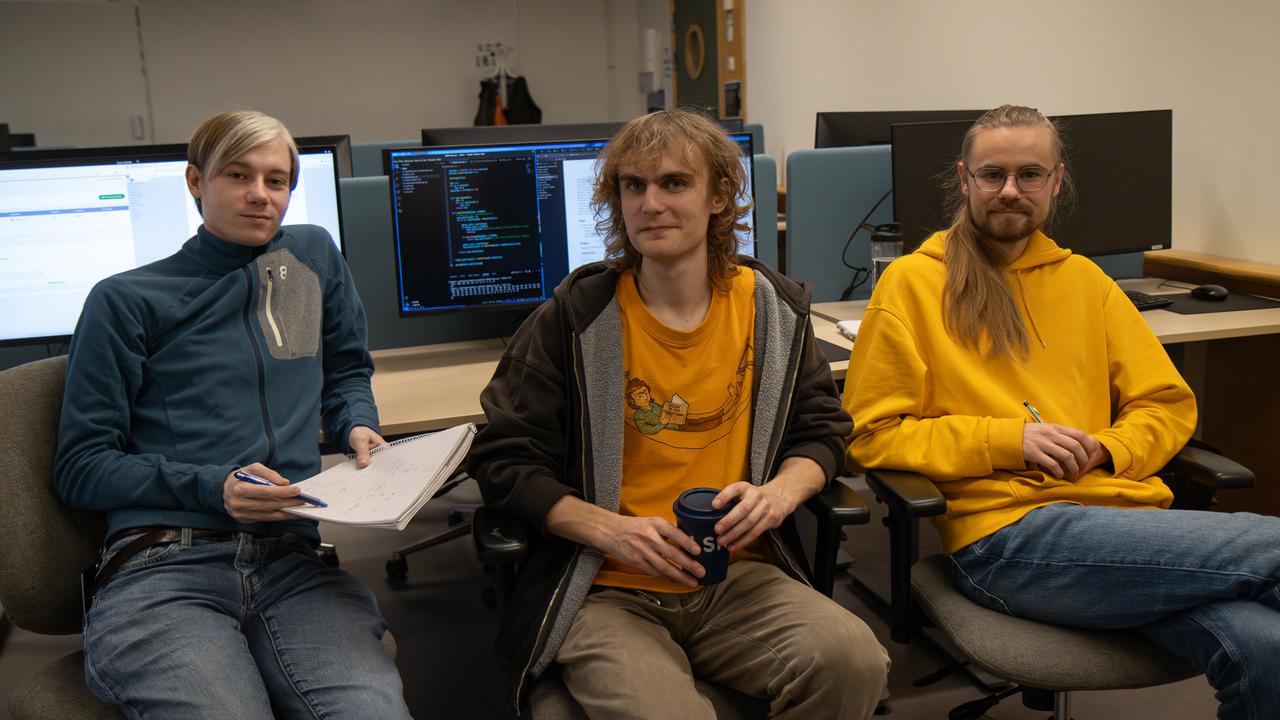
ImageJenny Karlsson
When you’ve been stuck on something for a long time and finally get it to work, that’s the best part of programming.
Ture Goldkuhl, Algot Heimerson, and Simon Cederfjärd are all studying at Umeå University and also work as teaching assistants at the Department of Computing Science. They recently competed in the Swedish Programming Championship, which also serves as the Nordic Championships. At that competition, they participated in different teams, but afterward decided to join forces and register together for NWERC, meaning they will represent Umeå University in Germany.
NWERC is a programming competition where teams from universities across Northwestern Europe attempt to solve a series of algorithmic problems. Each team aims to solve as many problems as possible within a five-hour time limit. Submissions are sent to an automated judging system that evaluates the solutions. The difficulty level of each task is not indicated, which means strategy plays a major role.
– The problems aren’t sorted, so you need to scan through everything and try to start with the easiest tasks to use the time efficiently, says Ture.
The group is preparing by working on developing a shared method and using their individual strengths effectively. Simon, who has a background in mathematics, often handles the theoretic problem-solving, while Algot and Ture focus more on programming.
– When you’ve been stuck on something for a long time and finally get it to work, that’s the best part of programming, says Ture with agreement from both Algot and Simon.
– We always solve the problems on paper first before we start writing any code, Simon explains. If you sit down at the computer immediately, it’s easy to get stuck and end up having to rewrite a lot afterward.
To prepare, they practice using competition tasks from previous years. They also highlight the course Applied Algorithmic Problem Solving as especially useful, since it includes tools and assignments similar to the competition format. All three are looking forward to traveling to Germany and putting their skills to the test in an international setting.
– It feels really exciting! We don’t have any specific expectations about the results, we’re mostly going for the experience, says Algot.